Friday, July 19, 2013

Special Situation of Artists

Cuba's '1 percent' is not who you think it is

   Text Size  
Published: Friday, 19 Jul 2013 | 7:00 AM ET
By:  | CNBC Chief International Correspondent
Twitter
30
LinkedIn
4
Share
Justin Solomon | CNBC
In most parts of the world, artists struggle to make a living. In Cuba, they're part of the wealthiest 1 percent of the population.
Two quirks of fate have led to an explosion of well-paid artists on the island: an exception to the U.S. embargo on Cuban goods that allows Americans to spend money on Cuban art, and an accident of Cuban history that lets artists keep the money they earn.
Dionel Delgado, 29, is emblematic of financially successful Cuban artists. His new gallery is in an apartment he just bought in a prime ground-floor location in old Havana that gets lots of tourist foot traffic.
As he painted a large, lush landscape of the Cuban countryside, he told CNBC, "A big part about my work is about the landscape. The love of my country, my space, my dream space."
Inside Cuba's Economy
CNBC's Michelle Caruso-Cabrera is one of the few business journalists who has been asked to visit Cuba. Why would the socialist government extend the invitation? She has the latest from Havana.
Don't try to buy the work however—it's already sold to a Mexican gallery for $10,000. He said that, on average, he sells a painting every two months.
Thousands of Americans travel legally to Cuba every year under what the Treasury calls "people to people" licenses. Remember Jay-Z and BeyoncĂ©'s trip? On such junkets, American tourists are prohibited from buying any kind of souvenir—except for books, music and art.
As a result, as one moves through old Havana, some of the most prevalent items for sale aren't T-shirts, hats or magnets, but paintings. In fact, the government put up a new building a few years ago expressly for art vendors.

An accident of Cuban history

Justin Solomon | CNBC
A false magazine cover painting from Cuban painter Dionel Delgado
Vendors there don't have to be as successful as Delgado to make a good living. Most of the paintings for sale to tourists are $100 or less. Selling just one a month, a painter makes more than double the average Cuban, who earns only $19 in a government job.
Artists have held a special place in the Cuban economy since the early 1990s—an extremely difficult period in which the Soviet Union cut off the billions of dollars in subsidies it had supplied to Fidel Castro's government. Even food was hard to come by. During that time, the government carved out a special exemption for musicians and artists, allowing them to travel freely in and out of the country and, more importantly, to be self-employed as artists and to keep the money they made.
The exemptions made them rich compared with other members of Cuban society, as well as more cosmopolitan.
Cuba on the verge of change?
Though Cuba is allowing a small private sector to exist, Ted Henken of Baruch College discusses whether the nation is really on the verge of change.
Abel Barroso Arencibia, 46, who specializes in wood carvings, agrees that artists are lucky to hold a special place in the Cuban economy.
Barroso is in the middle of a major renovation on his apartment. Two museums in New York—the Whitney Museum of American Art and Museum of Modern Art—hold his pieces in their collections. He has traveled all over the world, from the U.S. to Japan, and was able to do so long before other Cubans, who received that right only at the beginning of this year.

Critical of the government? It's up to the viewer

Justin Solomon | CNBC
A Delgado magazine-cover painting
Also remarkable is that the Cuban government seems willing to tolerate art that could be interpreted as critical of it. Barroso, for example, is working on a woodcut of a tablet computer. It obviously doesn't work, but the "apps" on the wooden machine are all related to emigrating from Cuba.
Barroso makes many woodcuts of communication devices. He calls the work an "ironic" commentary on technology. When asked if it's a criticism of the government—given that most Cubans don't have a cellphone or access to the Internet—he responds, "How it's interpreted is up to the viewer."
Besides landscapes, Delgado has created a series of large-format paintings that depict fake magazine covers. He said he was inspired by Norman Rockwell, famous for painting real magazine covers that portray an idyllic American life.
One of Delgado's magazine cover paintings shows people preparing to jump over the malecon—the famous seawall in Havana—in inner tubes. It's a scene repeated by thousands of Cubans who, desperate to leave, took to the open ocean.
When asked if the painting is intended as a criticism of the government, Delgado said no, adding that "it talks about the troubles of Cuba."
"It's normal for all the Cubans to have this constant on our minds," he said. For a Cuban, the sea means "one way to take his dreams out there, the American dream," he added. "It's a reflection of ... how many people take this option, you know? For finding a way, you know?"
—By CNBC's Michelle Caruso-Cabrera
Editor's note: Michelle Caruso-Cabrera owns works of Dionel Delgado, among works of several other Cuban artists.

University of Alabama Alumni Association Has License

UA Alumni Association plans trip to Cuba

Posted: Jul 19, 2013 8:13 AM EDTUpdated: Jul 19, 2013 8:13 AM EDT
By WBRC Staff BIRMINGHAM, AL (WBRC) -
For most Americans, what they know about Cuba is from what they've seen on TV or what they have read, due to travel restrictions.
A group with the University of Alabama will soon get an opportunity most people never get. The University of Alabama Alumni Association is now what they believe to be the only license holder in the state of Alabama to travel to Cuba in this way.
The alumni association says it took about a year to get the license from the U.S. Government and it comes with restrictions. The weeklong trip in November is in the planning stages right now, and it's open not just to UA alums, but also their friends and family. It has to be clear that it is not a vacation, but a cultural exchange. Commercial flights do not travel into Cuba, so the plane will be a charter. All the payments have to be made up front, because U.S. credit cards are not accepted in Cuba and exchanged U.S. money is tightly controlled in Cuba.
"The license actually comes from the U.S. Treasury from the Department of Foreign Assets Control. It took almost a year for us to apply," said Tour coordinator Ashley Clayton. "We did a lot of research. We basically have to prove that we are a legitimate educational interest and that we are not going there on a vacation."
The University of Alabama actually has a decade long relationship with the University of Havana and this idea grew out of that. Spots are still available on the trip. If you're interested, you can contact the UA Alumni Association.
Copyright 2013 WBRC. All rights reserved.

Thursday, July 18, 2013

Legal Travel by Ship

Company plans people to people Cuba trip by ship

Updated 2:59 pm, Thursday, July 18, 2013

NEW YORK (AP) — A U.S.-based tour company on Thursday announced the launch of new people-to-people trips to Cuba that would transport U.S. citizens there by ship.
Road Scholar, a Boston-based company, is offering the trips from Jamaica and Miami, with stops in Havana and other parts of Cuba.
Most travel by U.S. citizens to Cuba is outlawed, but tens of thousands of Americans now visit the island legally each year on people-to-people tours, which are licensed by the U.S. Treasury Department. People-to-people trips must have educational and cultural exchange itineraries in order to be approved by the U.S. government.
Typically people-to-people tours fly from U.S. airports to Havana on chartered planes. But Road Scholar's director of international programs, Yves Marceau, said in a phone interview that "there's nothing in the regulations or guidelines" that preclude traveling by ship on a people-to-people tour.
The U.S. Treasury Department confirmed in an email that transportation "whether by bus, boat or taxi" in Cuba is permitted as part of the people-to-people programs as long as it does not detract from a "full-time schedule of educational activities that will result in meaningful interaction between the travelers and individuals in Cuba."
Marceau said Road Scholar had "designed all the port programs to be consistent" with those regulations, including a visit to an agricultural cooperative and meetings with artists.
The Road Scholar trips are among several seaborne voyages planned by U.S.-based entities to Cuba. This fall, Semester at Sea plans its first stop in Cuba since 2004, according to Semester at Sea spokesman Andrew Centofante. Semester at Sea allows college students to earn credit on multi-country study abroad programs that take place on a ship, and Centofante said the Cuba stop was approved by the U.S. government as part of an itinerary in which students will visit various ports around the Atlantic.
The Metropolitan Museum of Art in New York had advertised a people-to-people cruise from Jamaica to Havana this past April, but it did not take place. A spokesman for Academic Arrangements Abroad, which was organizing the museum trip, did not immediately respond to a request for comment, but it's not unusual for tours sponsored by museums or universities to be cancelled if they don't get enough participants.
The Road Scholar trip will use a cruise ship operated by a Canadian company, with Canadians and Europeans making up most of the other 1,000 passengers on the ship, Marceau said. The Road Scholar group has room for 24 participants and will adhere to its own itinerary in Cuban ports.
One of the Road Scholar tours is an 11-night trip beginning in Montego Bay, Jamaica, which heads to Punta Frances, located on a small Cuban island south of Havana called Isla de la Juventud, and concludes with five nights in Havana. A second 10-night trip starts in Miami, then heads to Cuba, with stops including rural areas and the western part of the country, and a final stop in Montego Bay. The third Road Scholar voyage runs 12 nights, traveling from Miami to Havana and around the island before returning to Havana. The Road Scholar seaborne trips to Cuba have departure dates in December through March 2014.
The people-to-people cultural exchange licenses were reinstituted by the Obama administration in 2011, after being halted by the Bush administration. But requirements were tightened last year after criticism that many of the trips were masking recreational tourism to the Communist island. Cuban-American Republican Sen. Marco Rubio of Florida criticized the government for approving licenses for groups that included activities like salsa dancing

.

Thursday, July 11, 2013

Troy University Travels from Alabama

TROY – Four Troy University students will become the first to plant the Trojan Flag on Cuban soil in late July when they participate in a study abroad trip to the island nation.
Just 90 miles off the tip of Florida, Cuba has long been off-limits to Americans, but recent changes by the federal government have opened the way for students to travel there for organized learning experiences.
“We will expose our students to the culture, geography and history of a land that has been largely off-limits to the average American since 1960,” said David “Doc” Kirby, a journalism lecturer who has made five trips to the country as a musician. “The musical heritage of Cuba has been an enormous influence on American music of the last 70 years, for example.”
The students will also attend lectures at Cuban universities and participate in cultural immersion opportunities.
“For our foreign-language students, they’ll get to experience first-hand a very diverse Latin American culture that has been somewhat insular. This means the language has developed in different ways than in other Central and South American nations,” he said.
The 12-day trip – 10 of which are in Cuba – actually begins with students visiting the Cuban-American Ybor City community in Tampa, Fla. to familiarize themselves with Cuba’s culture. The study-abroad tour will land the group, also guided by Dr. Johanna Alberich, an assistant professor of Spanish, in Havana, Holguin and Santiago.
In Havana, the students will visit historical sites, observe rehearsals of the National Concert Band and the National Symphony Orchestra and pay a call to the Plaza de la Revolucion before heading to Holguin. There, the group will see historical sculptures on city squares and visit radio stations. Not to escape attending classes, faculty will conduct classes on Playa Guardalavaca, the beach where Christopher Columbus landed.
They will observe the rehearsals of the Province Band and the Holguin Symphony Orchestra, and have lunch with music directors of both. The group will also observe classes at the University of Holguin. Heading to Santiago, the Trojans will take San Juan Hill and have class on the War for Cuban Independence from Spain. Observation of classes at the University of Santiago de Cuba and visit to cultural and historical sites are also planned.
Joining Kirby and Alberich as chaperones are Dr. Shari Hoppin, an associate professor in the Hall School of Journalism and Communication and Lisa Vardaman, an education subject specialist in the Wallace Library.
Making the trip are students:
• Rachel Wallace, a junior broadcast journalism major from Helena;
• Phillip James, a junior Spanish major from Fort Walton Beach, Fla.;
• Haley Rae Davies, a senior Spanish and anthropology major from Fort Collins, Colo.; and
• Joseph Mitchell Markett, a student from Opelika.
Kirby also said the team will be establishing connections in governmental and education venues so that future trips could be offered with expanded areas of study.
The team leaves on July 29 and returns to Alabama on Aug. 9.


Not yet possible for Americans...

New Tall Ship Cruises in Cuba

Tall ship cruise specialist Star Clippers has announced new ports, new destinations and new itineraries for 2014 on board the line’s three head-turning sailing ships, Star Clipper, Star Flyer and Royal Clipper.
In February 2014, Star Flyer will operate a maiden season in Cuba, returning to the island for second season from November 2013.
Maiden Cuba season for Star Flyer

The 170-passenger Star Flyer will sail to Cuba for the first time in February 2014, offering a series of seven-night itineraries out of the historic southern port of Cienfuegos, calling at some of Cuba’s most beautiful beaches and anchorages, as well as the Cayman Islands. From November 2014, the ship will return to Cuba offering cruises from five to seven nights. There will be options to extend each cruise in Havana, the island’s capital.
This exciting new season for Star Flyer commences with a 14-night repositioning voyage from Balboa, Panama, to Cuba – a unique opportunity to enjoy a Panama Canal transit, two calls in Colombia and a visit to the Cayman Islands, departing February 2, 2014.
 
Eastern and Western Mediterranean and Caribbean
Many popular itineraries are continued for summer 2014, not least Star Clipper’s series of sailings from Athens to various Greek islands and Turkish ports, as well as longer, 11 and 12-night Western Mediterranean itineraries on Royal Clipper, sailing between Venice and Rome. Winter 2014/15 sees all three ships sailing the Caribbean, with a choice of departures from Barbados, St Maarten or ports in Costa Rica and Cuba.


Monday, July 8, 2013

Tampa Opts for the Future, Miami for the Past

Tampa and Miami in Cold War Over Cuban Trade


Credit Photo by Eric Barton
A Cuban band plays in the main terminal of the Tampa airport to promote flights to Cuba.
Quietly at first, and now quite publicly, the city of Tampa has courted Cuba in hopes of becoming its future trading partner. Business owners in Tampa talk of how they’ll capitalize when the island opens up, and politicians make trips there and have come out against the embargo.
Things are far different across the state in Miami. Elected officials there favor the trade embargo. Business leaders, fearful of retribution, rarely speak about future trade with the island nation.
Miami may seem poised to benefit most when the embargo ends, with its close proximity and much larger Cuban-American population. There are 982,758 people of Cuban ancestry in the Miami metro area, compared to 81,542 in the Tampa Bay area.
But Tampa has spent the past decade on a careful plan to build relationships with Cuban officials. It began more than a decade ago, with a trip in 2002 from Tampa’s mayor. A city councilwoman followed with multiple trips over the last decade, and in May, the Greater Tampa Chamber of Commerce organized a group of 38 politicians and business leaders who traveled from Tampa to Cuba.
Tampa politicians talk of expanding direct flights to Havana. They want Tampa to be home to cruise ships that call to Cuban cities. And they imagine the Port of Tampa becoming the main hub of goods heading to the island once the embargo is lifted.
JosĂ© Gabilondo, the Cuban-born law professor at the Cuban Research Institute atFlorida International University, said Tampa city leaders hope to exploit Miami’s reluctance to trade with Cuba. “Ironically Miami may be the only major city in Florida that’s not actively preparing for more engagement with Cuba,” Gabilondo said.
It’s unclear how much Miami’s reluctance to talk about doing business with Cuba will hurt the city once the island opens up, Gabilondo added. Anti-Castro groups in Miami have created bad blood with the island that could make it harder for the city’s businesses to forge alliances. As Miami continues to speak only of the embargo, Tampa prepares to exploit longstanding ties with Florida’s communist neighbor.
Tampa’s Cuban Courtship
Credit Photo by Eric Barton
Patrick Manteiga's grandfather, depicted in the painting behind him, started the Cuban-focused paper he now edits.
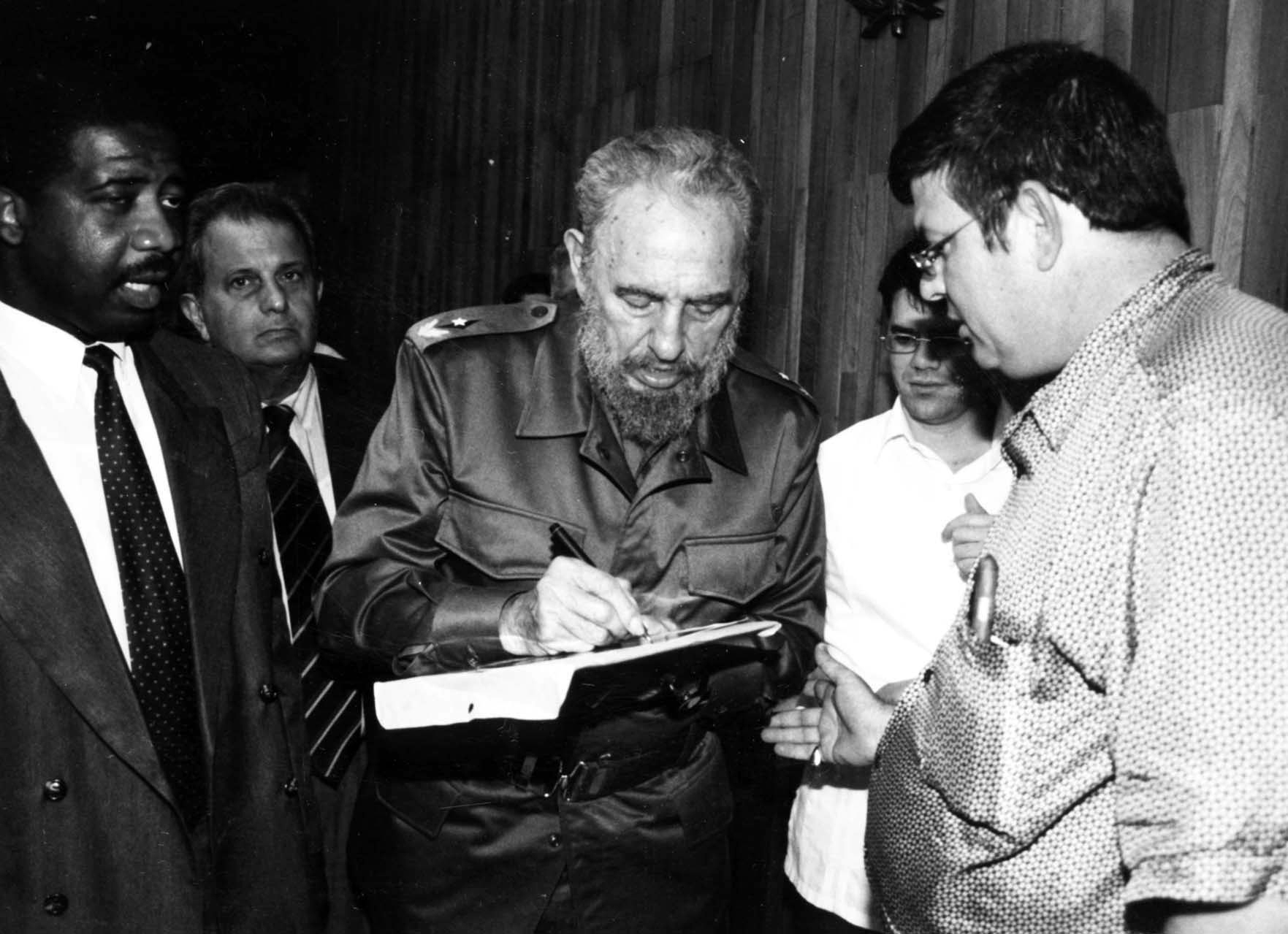
A signed photo of Fidel Castro shows the future dictator in Tampa to receive money for the revolution.
Patrick Manteiga paused in the hallway of the offices of La Gaceta, the Cuban-focused newspaper he owns in Tampa. His grandfather founded the paper in 1922 after spending years as a reader in the Ybor City cigar factories, shouting out the day’s stories to the workers. Manteiga said he circulates 18,000 copies a week in 44 states.
“Here’s our wall of fame or shame, depending on how you want to look at it,” Manteiga said, grabbing a photo off the wall. “Here’s a picture of my grandfather with Fidel Castro, and this is in 1956. And on the table is cash for the revolution. Then there’s another picture here of myself and Fidel Castro.”
Manteiga has published editorials in favor of lifting the embargo. He’s traveled to Cuba. He even met with Fidel Castro and had him sign a photo -- it shows Manteiga’s grandfather sitting with Castro at a table overflowing with money raised for the revolution.
Fidel Castro signs a photo for Patrick Manteiga. The photo he's signing is a shot of Manteiga's grandfather giving Castro money for the revolution.
“By now a lot of the punches aren’t nearly as hard when you say America’s position with Cuba is wrong,” he said. “Fifteen years ago, if we would have said this in Miami, we would’ve had our building firebombed.
It’s difficult to imagine such photos hanging on the wall of a Miami-based newspaper, but this is Ybor City, home to a Cuban population considered far more moderate to the rule of Fidel and RaĂşl Castro.
The moderate politics are rooted in history. Tampa’s Cuban population is made up largely of descendants from cigar factory workers who came from the island in the 1800s and a new influx of immigrants who arrived in the last two decades, said Arturo Lopez-Levy, a Cuba expert at the University of Denver. Both groups support lifting the Cuban embargo in greater numbers than the exiles of Castro’s revolution, who most lively in or near Miami and are more likely to have seen loss of property, mass murders, and torture at the hands of the dictator.
“Tampa isn’t pro-Castro, but it’s a population that’s more realistic about the effectiveness of the embargo,” Lopez-Levy said. “Even those who oppose the Castro brothers don’t make the embargo a litmus test.”
In 2002, then-Tampa Mayor Dick Greco and 19 business leaders traveled to Cuba. Greco, the son of an Italian immigrant, grew up in Ybor City. His trip was the first by a Florida mayor to Cuba in 40 years. Cubans in Tampa flooded Greco’s office with angry phone calls and emails, especially after the mayor admitted to spending five hours with Castro.
But Tampa has become far more moderate since, according to City CouncilwomanMary Mulhern. She has traveled to Cuba three times, most recently with the chamber’s trip in May.
“It’s true that the backlash has been loud and vitriolic,” Mulhern said. “But I could count the number of people who have objected on one hand – and with not many fingers.”
Mulhern’s interest came from a meeting with Albert A. Fox Jr., a former congressional aide who now runs the Alliance for Responsible Cuba. His group advocates for lifting the embargo, and he picked Tampa for its headquarters because of its moderate politics.
“Miami is almost irrelevant to U.S.-Cuba relations,” Fox said. “If the embargo is lifted tomorrow, Tampa has a leg up on every other city in America because of this historical cigar connection.”
Fox has helped convince several Tampa-area politicians to come out against the embargo. In April, U.S. Rep. Kathy Castor, D-Tampa, became the first member of the Florida delegation to call for an end to the decades-old policy. Castor, who did not return phone calls for this article, also traveled to the country in May.
 
In an article published on her website, Castor said the country has made reforms that remind her of “the historic economic changes since the 1980s in the former Soviet bloc countries, and in China and Vietnam over the past 25 years.”
Credit Photo by Eric Barton
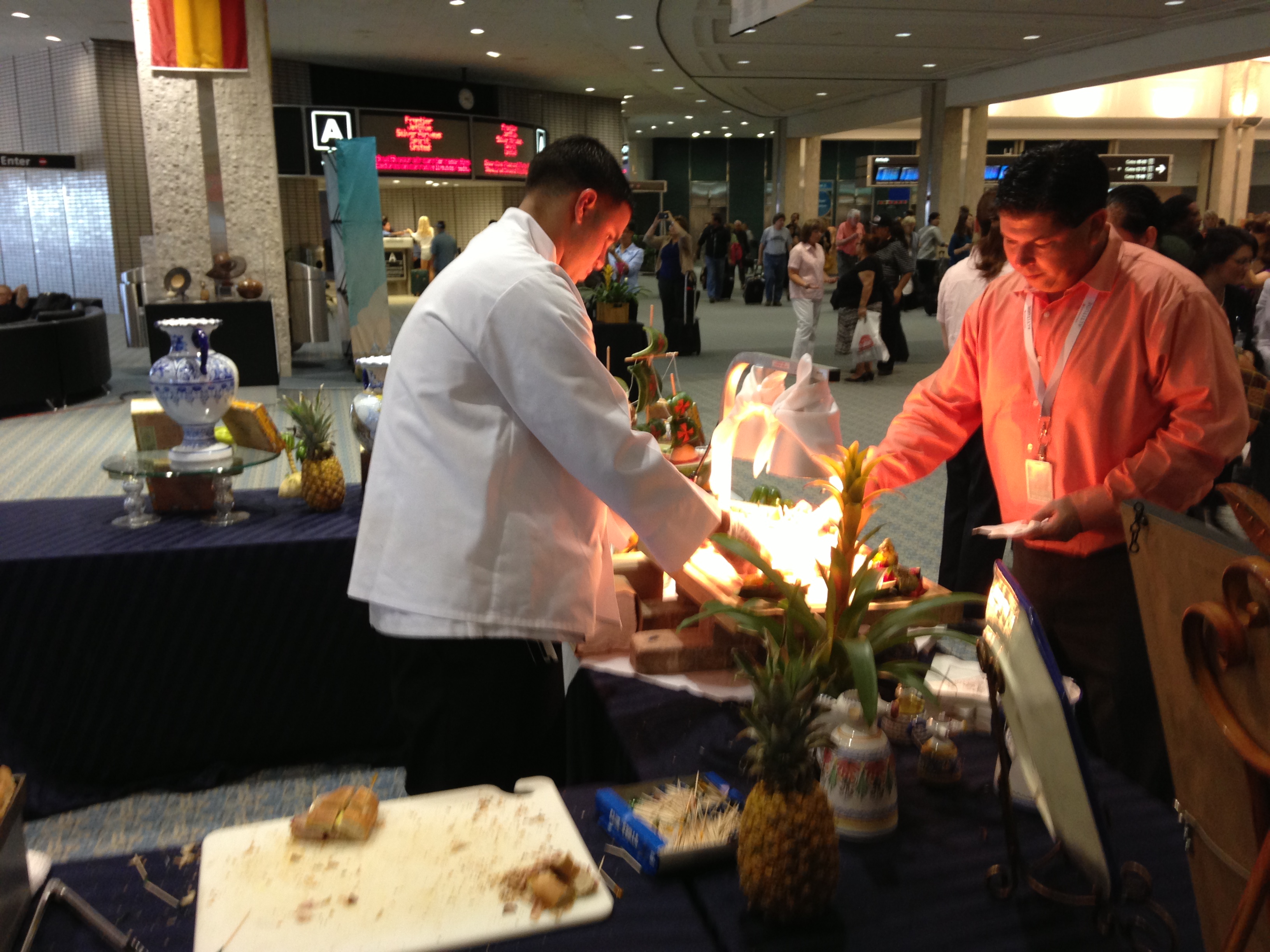
The Columbia Restaurant handed out sandwich samples at the Tampa airport as part of a promotion of Cuban flights.
Now, Tampa International Airport is putting on a series of Cuban heritage events, including sandwich tastings and Cuban bands, to promote its direct flights to the island.
Business leaders discuss plans to expand one day to the island. Those who traveled to Cuba as part of the Greater Tampa Chamber of Commerce’s recent trip include the president of the Tampa Bay Lightning, executives from several area hospitals, and the president of Tampa’s University of South Florida.
When asked if Tampa is in a better position to invest in Cuba after the embargo, Greater Tampa Chamber of Commerce President and CEO Bob Rohrlack responded: “Hands down. Absolutely.”
Rohrlack said the chamber’s governing board has been planning for trade with Cuba for seven years now. Chambers of commerce are typically forbidden from getting involved in politics, but Rohrlack said he saw an opportunity for Tampa.
“People here understand that this 50-year-old policy is outdated,” he said. “It’s time we start thinking about what happens after the embargo.”
Originally the chamber planned to send one of its own with five others from the community. Hundreds of people expressed interest. Dozens signed up. Rohrlack said they had to cut the number off at 38. “Interest kept growing, and we just finally had to cut it off,” he said.
During the trip, Rohrlack recalls conversations with locals who referred to Miami as a city of anti-Castro politics, while they saw Tampa as place that grew up around Ybor cigar factories.
“In Tampa, there’s a celebration of diversity of Cubans, while in Miami there’s less acceptance,” Rohrlack said “This is going to bode well for us when Cuba opens.”
Tampa will add “at least 5,000 jobs overnight” when it happens, estimated Manteiga as he sat in front of a painting of his grandfather in the newspaper’s Ybor City office.
Cuba doesn’t have warehouses to handle mass shipping, so supplies will have to be brought in from a nearby port until they can be built. Florida strawberries, for instance, can’t be kept in bulk in Cuba, meaning weekly shipments from the Port of Tampa.
“Tampa has been the safety valve for Cuba for over 100 years,” Manteiga said, noting that Ybor settlers helped fund the Cuban independence from Spanish. “It’s going to be the same way after the embargo is lifted.”
Miami’s Hard Line
Credit Photo by Eric Barton
Musician Alina Bouwer wants to open a recording studio in Tampa once there are democratic reforms.
Alina Brouwer comes from a family of musicians. Her father and uncle are both composers and well known in Cuba. Alina fled to Miami in 1992. After the embargo is lifted, she imagines opening up a recording studio in Cuba. Maybe a music school too.
“I dream about going back to Cuba very often. I see my family, my kids, especially, being able to walk around Havana,” Brouwer said.
But Alina is like many exiles in Miami. She says she’s waiting for human rights in Cuba. And only then will she do business on the island.
It’s a common refrain among companies in Miami, where the official political opinion seems to be that nobody should do business with the island until there’s widespread democratic reforms.
But that’s unlikely to happen anytime soon, said Gabilondo of Florida International University. Instead, Cuba is likely to open up through a gradual lifting of the embargo and a slow progression to capitalism. Think the reforms of Vietnam rather than the near overnight conversion of Russia.
That slow march toward democracy is likely to benefit cities such as Tampa, Jacksonville, Fort Lauderdale and New Orleans -- and not Miami. Exiles in Miami insist that the Castro government shouldn’t be engaged until there are widespread democratic reforms and land is returned to those who had title before the revolution. That could hurt Miami’s chances of cashing in if Cuba opens slowly to U.S. investment.
Miami remains a place where companies fear reprisals for doing business with the Castro government. A Coral Gables travel agency that arranged trips to Cuba was firebombed last year, for example. Nobody has claimed responsibility for the arson, but Miami has a long history of companies meeting the match for even talking about an end to the embargo.
Blaine Zuver’s Coral Gables-based business advertises that it can set up adventure travel “from pole to pole.” Blaine calls his company Arctic Tropic -- but he’s quick to note the one place he won’t go.
“I don’t want to say I’d be blacklisted if I went to Cuba, but it’s highly discouraged,” he said. “My company has good connections here in Miami, and I would lose them overnight.”
Less than a month after the Tampa chamber returned from Cuba, Greater Miami Chamber of Commerce Chairman Alberto Dosal declined to speak about the issue, instead issuing an emailed response that read in part: “Once Cuba is a free and democratic country, the Greater Miami Chamber of Commerce would be more than happy to comment on doing business with the Pearl of the Caribbean. Until then, any conversation on the issue is moot and would be premature.”
The politics of Cuba was evident in Miami last year at a groundbreaking for Miami International Airport’s new train station. When Gilberto Neves, president and CEO of construction giant Odebrecht USA, stood to speak, three members of Congress in attendance walked out. U.S. Reps Ileana Ros-LehtinenMario Diaz-Balart, and David Rivera left in protest over the fact that Odebrecht’s Brazilian parent company has contracts in Cuba.
Adherence to that hard line is common among leaders in Miami. Anti-Castro groups remain major donors to Florida political campaigns. The most influential remains theUS-Cuba Democracy PAC, known simply as the Cuba PAC in Tallahassee and Washington, D.C. Based in the Miami suburb of Hialeah, US-Cuba Democracy PAC spent more than $400,000 last year, mostly in donations to federal candidates -- two thirds of them Republicans. Nearly all of Florida’s congressional delegation receives money from the PAC. The only one who doesn’t report contributions from the Cuba PAC: Tampa’s Kathy Castor.
Perhaps Miami’s most consistent critic of the Castro government is Javier Souto, the 74-year-old Miami-Dade county commissioner. Souto was born in the historic Cuban village of Sancti Spiritus, the son of an accountant and a lawyer. Souto worked for a year in Fidel Castro’s government before becoming disillusioned with the revolution. He left for Miami and then took part in the failed Bay of Pigs invasion. Souto served in the Florida House and Senate before being elected to the Miami-Dade County Commission in 1993.
When asked about Tampa’s courting of the Cuban government, Souto compared the city to countries that have ignored the U.S. embargo, such as Canada and Germany. “They don’t care about human rights, they don’t care about freedom of expression, they don’t care about any of that, these other countries of the world,” he said. “They only care about money.”
Tampa might think it will profit from doing business with Cuba, Souto continued, but he predicted the city would suffer instead. The Cuban government is known for ignoring debts, and it’ll likely ignore invoices from Tampa companies. “What Tampa is going to get from Cuba is a lot of aggravation and a lot of problems,” he said.
While Miami politicians publicly support the embargo, many speak privately about their desire to see it lifted, said Kathy Sorenson, a former Miami-Dade commissioner and head of the nonprofit Good Government Initiative, which educates elected officials on ethics. Behind the scenes, Miami businesses are quietly planning for an open Cuba, she said.
“There are lots of smart business owners in Miami, and believe me, they’ll figure out how to do business there once it opens,” Sorenson said.
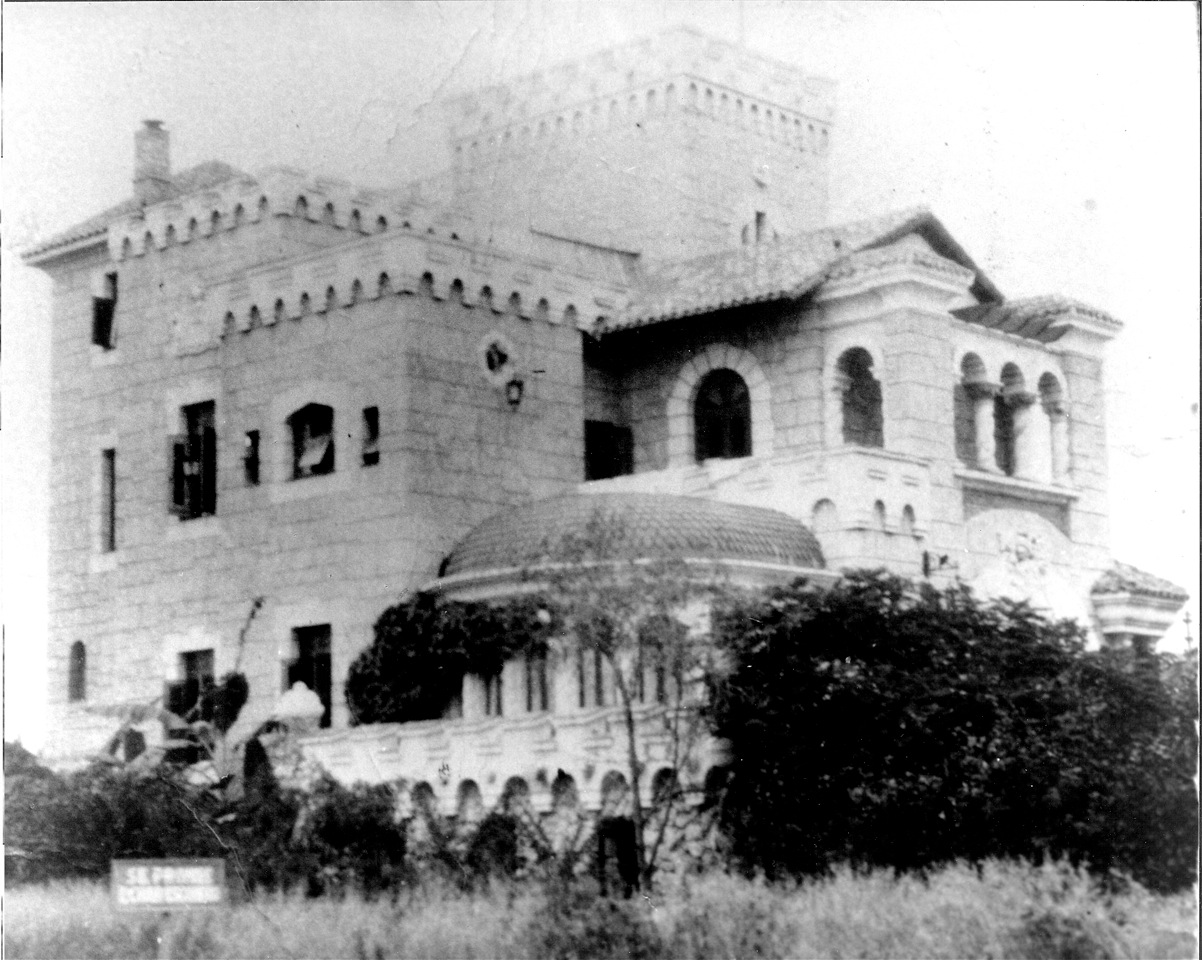
Fidel Castro's government seized the castle-like home that Mike Vidal's grandfather owned. Now he wants it back.
Like many in Miami, Mike Vidal objects to any dealings with Cuba until the island makes major reforms. Among them, Vidal wants back the land the government seized from his family, including his grandfather’s castle-like home, a copper mine, a cattle ranch, and a mile of pristine oceanfront property.
Vidal, a 57-year-old computer technician, comes from a politically connected family – his grandfather was speaker of the house and a United Nations ambassador in President Fulgencio Batista’s government. His father was an advisor to Batista.
“I consider myself pretty moderate when it comes to Cuba,” Vidal said. “But when it comes to doing business with Castro, or traveling there, I don’t want to see it happen until they return the land they took from families, mine included. Pay for it, or give it back to us.”
Cuba experts believe that’s unlikely to happen, and it’s a major issue that may keep Miami from profiting on Cuba’s slow reform -- to the benefit of cities like Tampa.
The Florida Center for Investigative Reporting is a nonprofit news organization supported by foundations and individual contributions. For more information, visitfcir.org. The Public Insight Network contributed to this report and can be found online here.
Potential Benefits of Cuban Trade
Florida businesses have been planning, largely in secret, for the lifting of the U.S. embargo for decades. Among the potential opportunities:
A Boon to Ports
Cuba lacks warehouses that could accommodate widespread shipping. That means importers would need to send smaller and more frequent shipments from nearby ports. Miami would seem to be the best fit for proximity, but larger ports in Tampa, Fort Lauderdale and Jacksonville will offer competition, as well as the nation’s largest port in New Orleans.
Shipping and Cruises
The Cuban Democracy Act of 1992 forbids any shipping or cruise vessel that has traded goods and services in Cuba from visiting a U.S. port within 180 days. An easing of that restriction would allow major cruise and shipping companies to add stopovers in Cuba. First, though, the Cuban government would need to show interest, since Fidel Castro in 2005 turned away most Cuba-bound cruise ships after complaints of trash.
Infrastructure Upgrades
All of Cuba’s basic utilities -- including electric, water and sewer -- rely on decades-old grids that would likely see an entire overhaul after the embargo. The electrical grid especially has suffered from a lack of upgrades and hurricane damage, with blackouts 125 days a year, according to a University of Miami study. Roads, ports, and airports also haven’t seen much construction since the Soviets pulled funding for the island two decades ago.
Maintenance Contracts
After the embargo, U.S. companies will seek contracts to run services in Cuba. But that business prospect is fraught with questions, especially since Cuba unexpectedly canceled a contract with an Italian company to run the port in Havana. International companies have also had little success challenging the details of contracts in Cuban courts.
New Wheels
Cuba’s 1950s-era vehicles make great photo ops, but a post-embargo run on new cars would be a boon to the port in Jacksonville, already a major hub for imported vehicles. 

Saturday, July 6, 2013

On-line booking for Cuban Hotels


Only available to Cuban Americans, until the President gives all purposeful travelers a general license....

Umbrella Travel Launches Social Media Campaign

Keeping up-to-date is ever important with advancing technology, especially when planning a vacation. Umbrella Travel is now present on social media to keep people informed when booking a hotel in Cuba.


Umbrella Travel
Umbrella Travel helps people book hotels in Cuba.
(PRWEB) July 06, 2013
With the summer season underway, many people start looking for vacation opportunities, typically at the last moment, and when those last minutes arrive finding great deals can be a challenge. For that reason, Umbrella Travel has recently launched a social media campaign to keep people up-to-date on the best deals, even at the last possible minute for booking a stay in Cuba hotels.
One online customer said that being as a Cuban American it is typically harder to book a vacation in Cuba, but they were able to find what that wanted through Umbrella Travel and was able to comfortably book a vacation and find a place to stay while vacationing in Cuba.
Umbrella Travel has started to focus on social media such as Facebook to help people find the best deals on Cuba hotels as well as sharing many vacation success stories. They share information about Cuban hotels that focus on certain cities such as Cayo Santa Maria hotels, which is a popular destination when visiting Cuba.
Twitter is also another popular social media source that keeps people up-to-date and Umbrella Travel is present with constant updates. They give great information about the communities as well as their hotels including the popular Havana hotels.
Umbrella Travel is also present on the new and upcoming Google Plus social media finding the best quality Cuban hotels, as well as important hotel announcements which permit people to +1 the posts and comments.
Cuba openly receives thousands of vacationers each year from around the world which speak many different languages, and for that reason, Umbrella Travel works hard to provide lodging opportunities to an international cliental by submitting bilingual posts on their social medias both English and Spanish. These bilingual posts help keep a large audience informed on the great deals that are available for the many Cuban hotels in Cuba.
The summer may be quickly passing by, but there is still time to book a last minute vacation to Cuba and to find a place to stay in Cuba for great memories and relaxation. Be sure to check out and like, or follow Umbrella Travel on Facebook, Twitter, and Google Plus for the latest information on Cuban hotels.