
A conversation with Ada Ferrer: Cuba, Cubans, and dialogue against all odds
While words like politics, equality, democracy, rights, and freedoms have been devalued in Cuba and many other countries, the issue of sovereignty still has concrete and experiential meaning for many Cubans.

Dear Ada, when your book Cuba, an American History won the Pulitzer Prize, all your friends and readers on the island celebrated it for what it was: a recognition of the best of Cuban historiography in the U.S. and of one of our most prestigious and beloved historians.
Before that article in the Granma newspaper that you remember, two reviews appeared in well-known magazines, Temas and Casa de las Américas , written by renowned historians, Francisca López Civeira and Oscar Zanetti.
Zanetti's review became her own words during the book presentation on April 6, 2023. The post that includes it, on the X de Casa profile , accompanied by four photos of you, announced that “Cuban historian Ada Ferrer spoke at Casa de las Américas with Cuban historians and American students about the presentation of her book ‘Cuba: An American History’, winner of the Prize in 2022.”
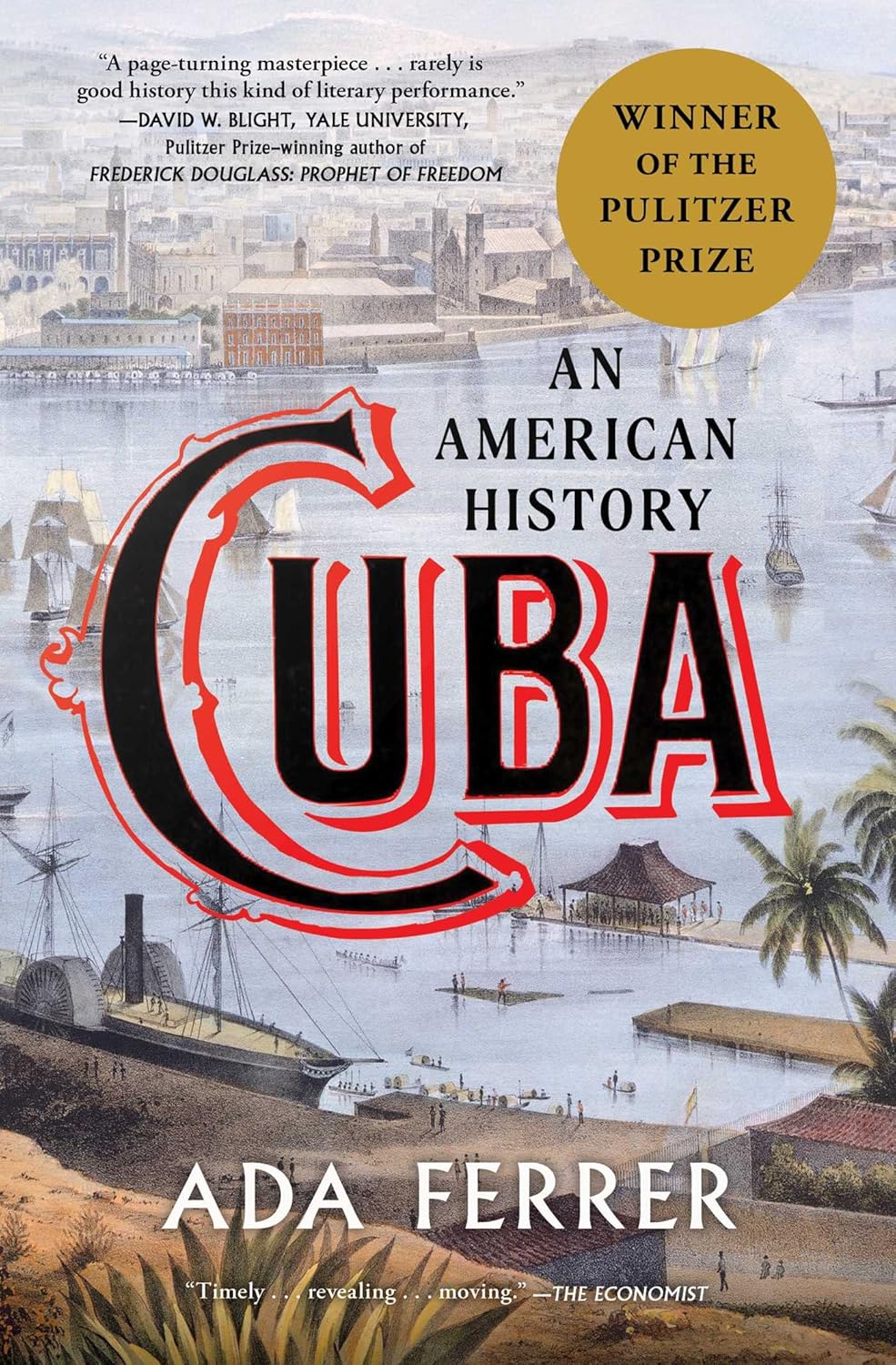
Indeed, a representation of the "cream of the crop" (as they used to say) of Cuban historians gathered there, along with a host of other academics and your followers, some of whom spoke to comment on its significance and congratulated us on having you with us that day. Your heartfelt words before the packed Manuel Galich Hall that April morning in 2023 moved us all.
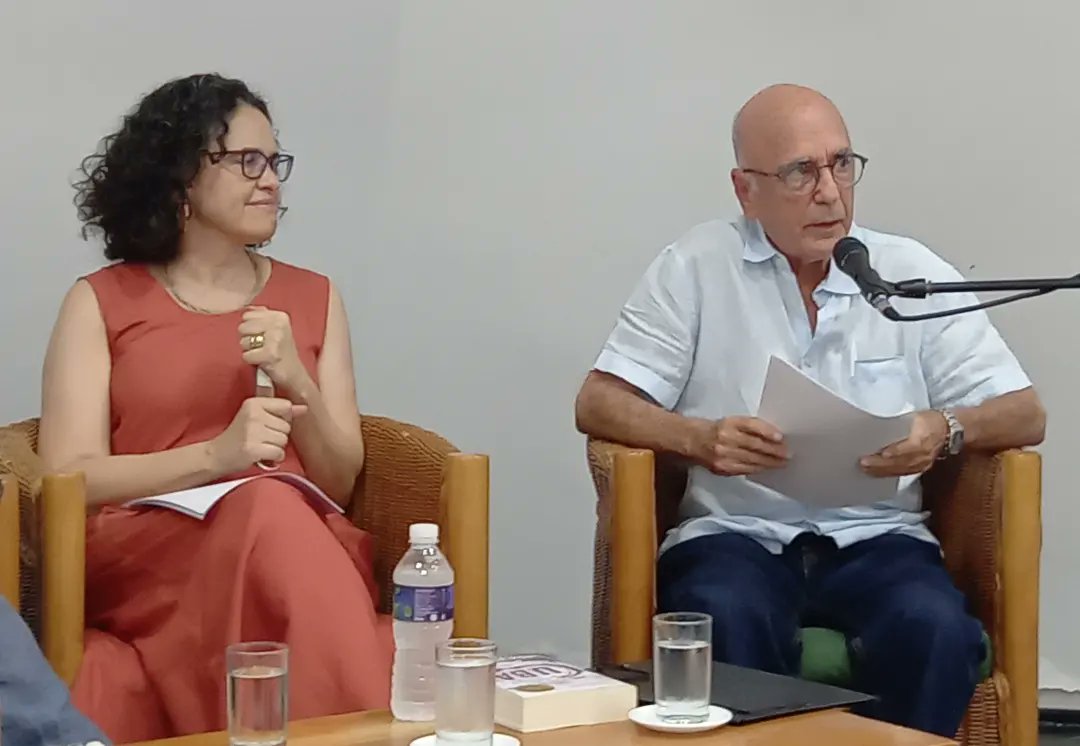
Ada Ferrer with historian Oscar Zanetti during the presentation at Casa de las Américas. Photo: X/Casa de las Américas.
The power that drew so many people to the presentation of your book wasn't solely due to your rigor and boldness as a historian, but also to your personal qualities, and in particular, your intellectual honesty. Because in our Cuban culture, more than intellectual, artistic, or purely ideological values, prestige depends on civic virtues and ethical conduct, especially when appealing to national unity and fostering a genuine spirit of dialogue. As you know, not everyone who advocates for a "national dialogue" possesses these qualities or is credible. My respect, as they say here, for those hard-won merits.
Your words that day at Casa reminded me of our meeting more than ten years earlier, when you were leading a group of boisterous New York University students visiting the Juan Marinello Center, and you invited me to give a short course on US-Cuba relations. You told me then that you were going to be a mother (I think) and entrusted them to me for the following year. I accepted, sincerely honored and also happy for the opportunity.
I always say that there's no better way to explore national dialogue or examine the relationship between our countries than by teaching it to U.S. students, especially when they are Cuban-Americans. I've been learning this ever since I first had them at Columbia, 35 years ago; at Harvard and the University of Texas (where I learned you earned your master's degree in History), and now with the students at the Brown University Consortium, with whom I just finished a semester at Casa de las Américas last week.
This exercise in learning and dialogue has led us to read or reread together well-known or recently declassified historical documents, interview key figures and anonymous actors from both sides, review and compare data, debate in class the theses of the most prestigious historians and the perspectives of "people without history," and especially, subject to collective critique "everything that exists" in this odyssey filled with centuries of conflict and social interactions that connect our destinies. For without this joint exercise, it is difficult to understand the Cuban revolutions, or Cubans anywhere. And even less so the history of the present.
A family history
Reading your letter to the president's allusion to our relationship with the U.S. as a family history, I was reminded of the lessons I learned from my students and their families, some from the upper echelons of society, with whom I had the pleasure of conversing peacefully in their homes in Coral Gables. And of those learned from my own family.
Almost half of my maternal uncles left between 1963 and 1967, taking my cousins with them, including the one I missed the most: my maternal grandmother. She left against her will, accompanying my youngest aunt with two small children. She had been a public school teacher during the two republics before the 1959 Revolution, in rural areas and later in the town of Cabaiguán, half of whose residents greeted her in the street with a bow because she had taught them to read and write.
She was a devout Catholic and, on principle, considered politics something nefarious, but she was also the mother of my revolutionary uncles and my own mother, and the widow of a tenant farmer who had lost everything in 1929 because he couldn't pay the rent. So she wasn't blind, nor did she blame Fidel Castro for everything bad, including the family division, since those differences had existed between them before 1959. A teacher at heart, she knew how to think.
That grandmother, who instilled in me all the patriotic values, social justice, and civic awareness that I can still hold onto, and who was anything but a communist, used to say that there had never been a government (she had known them all) that had done so much for education.
I don't know if she took with her the medal for 50 years of teaching that the MINED awarded her, of which she was proud, when she left, attending to the youngest of her daughters.
My heart has never stopped being with all those uncles and cousins who live there.
As you know, Ada, those family stories aren't always the same. Almost all of us have lived through it, each in our own way, including those of us who could have left but didn't; because we were lucky enough not to be taken without being asked.
I myself almost crossed that point of no return, the same one that 15,000 children went through, sent away out of fear of being sent alone behind the Iron Curtain, only to end up alone anywhere in the U.S., as happened to a younger cousin of mine. My mother, who only had a sixth-grade education, had received a letter from the headmaster of my Presbyterian school, offering to take me under the wing of the American churches and guaranteeing me a bright future. I was 13 years old, and with just a little push, I would have left. But she tore it up.
Instead, he encouraged me to go and teach literacy classes, along with my other cousin, in the Escambray Mountains. Although at home they always told me we were poor, after seven months with those generous farmers, we had learned what true poverty was. More than slogans, communism, or Marxism, which most of us didn't understand, we discovered that these poor people of the land were the very essence of the Revolution. When we came down from the mountains, we were different people: we had become revolutionaries. So, if they had wanted to send me to the North back in 1962, at the age of 14, they would have had to drag me there.
A social history and a different vision of politics
Reading your book and your letter (“My Father Wrote Letters to the Cuban Government. Here Is Mine,” published in Spanish on May 8, 2026, in the New York Times), it occurs to me that if we were to give the millions of Cuban family stories—similar or very different, including yours and mine—to an artificial intelligence processor, perhaps we could project a virtual sphere, rich and fascinating, where the real social relationships between the two countries would intertwine over the last almost seven decades. If that were possible, we would see more clearly what unites us, and also what separates us, both here and there.
That projection would also have to take into account our social heterogeneity, which has been growing since the 1980s (as sociological studies show), in addition to other features that differentiate us today in various ways, and which are not "economic" either.
From that recognition, we could look deeply at the issue of inequality, instead of believing it to be an epiphenomenon of the crisis; as well as understanding that incessant migratory flow, incomparable with episodes like those of Mariel and the rafters, which expresses a structural transnationalization of Cuban society, and which will not be shut off like a key when we change the gasket on the economy.
It could also help us understand the arduous path of national unity as a process, linked to dialogues and debates from below, that can contribute to enriching and transforming the real political culture, that of the led and the leaders, through the participation of the people, instead of by the grace of agreements from above.
The point I'm most interested in discussing in your letter is how far we've come in building a public sphere where horizontal dialogue and critical debate can take place. A space that allows us to think of national unity not as an ideal goal, but as a process, a floating horizon, not reached simply through a gesture from the government, but as the result of a transformation in the political culture of real Cuban society .
When characterizing that society from an inclusive perspective, we would also have to encompass the "below" and "above," "inside" and "outside," as is logical.
There, and only there, resides the energy for change toward a new (and unknown) order, the resistance to calamities and harassment (which, like everything else, wears down over time), the defense of the national interest (which needs to be redefined as something living and current). But in that vision of Cuban society as a whole, one would have to recognize the conservative factors that slow down change or question it (not only "at the top"), due to distrust of a different (and unknown) order, the fear of the side effects of a "better" relationship with the US (which we have never experienced for more than a few months), the impact of social media, which, by saturating the public sphere, muddies more than it clarifies, and fosters a homogenizing common sense (opposed to sound, differentiating critical sense), whose reach, incidentally, includes many intellectuals.
As for the political class, Raúl Castro himself recognized the importance of this cultural transformation from a conservative pattern, when he reiterated his criticism of "the old mentality"; and when he specified that democratization as a requirement of a new socialism encompassed that of the Party.
That the government must respond to its responsibilities is too obvious to need arguing here. It holds the levers of power, an excessively centralized authority (one of the system's weaknesses) that it doesn't use effectively, while often hindering the search for and implementation of solutions; media outlets that are hardly a reflection of the national reality (nor are those of the opposition); a system of representation that, at the local level, could make People's Power the vehicle for empowering all social groups, especially the most disadvantaged , and that, at the top, could constitute a semi-parliamentary regime more democratic than any presidential system (and more faithful to the Constitution), whose pluralism should not be confused with a multiplicity of parties dedicated to winning elections rather than transforming society.
In short, a socialist system, with a strong State capable of implementing reforms and, at the same time, protecting the most vulnerable groups, as well as guaranteeing security and sovereignty against the US; through a People's Power that truly controls and holds the Government accountable, and where the diverse currents of public opinion, including those of a loyal opposition, are felt and debated .
The good news is that these topics are being researched, discussed, and shared publicly in cultural and academic spaces, research centers and universities, social science and humanities publications, and even in plays, films, and narratives—something that wasn't happening twenty years ago.
Regarding the path of dialogue, we have also made some progress, and I would like to tell you about it from my own personal experience.
To dialogue, to debate, to listen, to understand
When we launched the monthly public debate forum Último Jueves in Temas magazine, on our own initiative, with the topic "Racial Violence in the History of Cuba," we imagined what it would cost us not only to get it started, but to maintain it. But we underestimated it.
These panels have brought together academics, journalists, artists, practitioners of various trades, activists, priests, teachers, writers, athletes, opinion leaders, babalawos (priests of Cuban religion), entrepreneurs, leaders of the Communist Party of Cuba and the government, officials, delegates to the People's Power Assembly, and military personnel; among them Cubans, Cuban-Americans, and people of numerous other nationalities. The issues they have debated have been legion—including those you raise with the president—and they have done so before an open, diverse, engaged, and almost always highly controversial audience.
These open debates held on recent Thursdays are not sufficiently covered in Cuban media, neither official nor opposition, and even less so in foreign media, whose correspondents are conspicuously absent. However, the fact that we are not on television does not prevent them from circulating, as they have been published in full not only in the magazine Temas, but also in printed and digital books, and even on DVD; and since the COVID-19 pandemic, we have been broadcasting them live on Telegram and transcribing them on our Facebook page every month.
Over 24 years and 242 debates, we've managed to weather the storm and keep the door open. We have enemies (as with anything worthwhile), some of whom understand pluralism as simply a gathering of people who think more or less alike; others who would be disgusted to sit next to some of our guests. They often declare that our Thursday debates exist because they're organized by "authoritative intellectuals" and we choose "permitted topics" to discuss. Faced with these diatribes, coming from both sides of the political spectrum, we simply invite them to participate. They never come.
The most useful thing we've learned is that freedom of expression is valuable because it's not a gift from above, but something that is earned. But above all, we've seen just how formidable a real challenge it is to cultivate a genuine culture of debate, without which we won't have a more democratic society. And that's why I say it's not enough for the government to simply promote it, as it does with other things, for it to truly flourish.
When I've asked about it, I'm told that the PCC's policy is to foster spaces like that. In my modest experience, it doesn't matter from what institutional framework they're promoted or what the topics are—whether it's contemporary Cuban theater or tropical fish farming—they always end up sparking political debate. And often, they don't last long, because what Liborio called "buying fish and becoming afraid of its eyes" happens.
Although I do not in any way overestimate the significance and scope of these debates of ours, I mention them to you only because they illustrate what can be done, with the determination and participation of many, from below and without waiting for guidance.
I would very much like you to share them with us. I was sorry you couldn't participate in the Temas workshop I invited you to the last time we met, where we discussed issues like the ones you mention in your letter. I hope you can join us, either in person or online, for some of the panels we have this year, including "Social Classes, Inequalities, and Poverty," "Untangling the Knots of Economic Policy," "Cuban Polycrisis," and "What Kind of Socialism Are We Talking About?" And if not, at least listen and participate in the discussion.
Understanding what's happening here is difficult, naturally, even for those of us who investigate society and politics on the ground. Doing so amidst the polarized clamor of social media, without delving into the current dynamics of Cuban critical thought, is like trying to understand what the river carries along at the bottom while simply going with the flow. Naturally, to connect with that thinking, linked to the practice of research and other forms of knowledge, as well as to balanced reflection, one doesn't need to be in Cuba.
It goes without saying that there are no simple answers to most of the more complex problems posed by the transition.
How wealth will be concentrated or distributed in Cuba ten years from now is a question that could depend on the depth of the reform policies implemented now. It depends on how the dichotomy between human development and growth is resolved; on the transformation of the state sector into a public sector; and on the coordination between that public and private sector.
But also the political changes I mentioned earlier, as well as the practical consolidation of civil liberties, along with everything else promised by the new Constitution. So that the system would increasingly reflect the society on which it is based.
I don't absolve the government of any responsibility in facilitating this transformation, and even less so in getting us out of this rut where daily life is paralyzed and the well-being of society as a whole is compromised. If the president doesn't respond to what we researchers write and argue, however, we shouldn't think he's blind or ignorant of these problems, much less that the government lacks qualified people who graduated from the same faculties as those who criticize its policies.
In fact, it's not just economic experts ranting on social media, in queues, at assemblies, and in the comment sections of digital media about the Economic Reorganization Plan, the shortages of food and medicine, the piles of accumulated garbage, etc., but everyone. Postponing or failing to implement the measures agreed upon in 2011 and enshrined in the new Constitution is their responsibility, along with that of the rest of the government and the leadership of the Communist Party of Cuba.
The siege and sovereignty: the besieged fortress
Although many Cuban intellectuals and journalists have criticized the constant invocation of the embargo for its counterproductive, saturating effect, I confess that I can't think of any aspect of Cuban life that remains untouched by the US siege, not just the embargo itself. When the president mentions it as an unavoidable factor in the landscape of our problems, he isn't revealing anything we don't already experience firsthand.
I agree that it is unreasonable to plan policy without taking into account the constant nature of this blockade and siege, which is unchanging and increasingly severe. Comprehensive and complex in its impacts, the siege affects all Cuban policies, not only those directly related to the economy, but also public health, education, culture, the media, and, of course, national defense and security, as well as permeating the social psychology of our people.
While words like politics, equality, democracy, rights, and freedoms have been devalued in Cuba and many other countries, the issue of sovereignty still has concrete and experiential meaning for many Cubans, old and young, and has been brought to the forefront by this intensified siege.
Indeed, the ferocity of the U.S. and the foreshadowing of an untimely attack against Cuba have brought hundreds of thousands into the streets, many of whom no longer participated in marches or had lost motivation; and it prompted them to remain for hours in the rain to honor our fallen in Venezuela, in a genuine demonstration of mourning, including numerous young people.
By the way, I want to mention that our sovereignty never depended on the USSR, much less on Venezuela. We disagree on that point.
From the Missile Crisis onward, the defense of Cuba was solely in the hands of Cubans on the island. This geopolitical situation was reflected not only in many speeches but also documented in the declassified papers from the tripartite conferences on the crisis in 1990 and 1992, where I had the opportunity to participate as an advisor, alongside veteran Cuban and Soviet politicians and military officers. This Cuban-Soviet alliance was, incidentally, a product of US policy, as McGeorge Bundy argued to JFK in a memo I found while searching through declassified files at the Kennedy Library in Boston.
The Cuban system would have been very different if we hadn't had to arm ourselves to the teeth, and if so many generations hadn't had to get used to living in training for a people's war against the U.S. That situation certainly marked us forever. And, unfortunately, it continues to mark us.
“A parliament in a trench,” as Cintio Vitier described it, is a critical situation, that is, quite difficult. Not getting our hopes up doesn't mean we should resign ourselves to a silent parliament; quite the contrary. But assuming that the solution depends on our flexibility and willingness to negotiate with the U.S. risks forgetting who our neighbor is.
No country—socialist, former socialist, revolutionary, or post-revolutionary—has had to pay such a political and social price as Cuba has for this poor neighborliness. However much it is invoked , sovereignty is not a mere ideologue.
I wonder: could we aspire to social justice, equity, human development, participatory democracy, human dignity, and civil liberties if, above all, we didn't guarantee sovereignty? What would José Martí have answered if he had been told that sovereignty isn't edible? To avoid unnecessary disagreements, I prefer to think that it was a poor choice of words , as they say there.
It is impossible to ignore that at a time like this, when US hostility toward that sovereignty is renewed, sensitivity grows toward any stance that downplays it , seems to diminish its real importance, or relativizes it in any way. This reaction includes not only the government, but all those who believe that this is the moment to close ranks in the face of the imminent use of force, or even the mere threat of it.
Dissent, heresy, dissent
As you know better than I, because you've studied them, since the 19th century there were members of the Creole elite, slave owners, and even prominent intellectuals born on this island who promoted annexation to the American Union. All of this was done in the name of the nation's prosperity, integration into a great democracy, and the preservation of a "genuine" Cuban identity—that is, a white one. For these annexationists and their Confederate allies, the independence fighters were radicals who would plunge the country into chaos and poverty in the name of freedom.
Now there are also Cubans, both there and here, willing to call for US intervention to escape this dark tunnel into which totalitarianism has supposedly led us, and to recover freedom and democracy for "our people," thanks to this integration. Something like, "If we're going to be dependent, it's better to be with the Americans than with the Russians or the Chinese."
They are also found in the world of culture and academia. Feeling that this is "what's coming," some of these late-blooming libertarians are positioning themselves, presenting themselves as the voices of this new Cuba.
They are visible in the most recent wave of dissidents, where renegade communists predominate—a term coined by Isaac Deutscher, who distinguished them from heretics, that is, those opposed to the dogma. Most of these renegades have done everything possible to get themselves censored, since their main merit is a pamphleteering style reminiscent of Patria y Vida (Fatherland and Life), and inciting social media attacks against the government, portraying it as the culprit for all ills.
The judicialization of how this dissent is handled not only raises questions about individual rights and freedoms, transparency, and information regarding all legal proceedings and prisoners, but also shifts the handling of what is essentially a political issue to law enforcement agencies.
The incongruity is compounded by censoring or imprisoning them, instead of testing the consistency of their positions in the political, ideological, and intellectual arenas; instead of confronting them in debate and the public square, judicial measures have turned them into celebrity cases. The end result has been counterproductive.
It wouldn't be difficult, however, to confront them in the arena of public opinion and expose their inconsistencies. These dissidents are the favorites of the U.S. chargé d'affaires in Havana, who defends them as the organic voices of the democratic and free Cuba he envisions in his work plan. Their trajectories are so well-known in intellectual circles that their proposals to promote statements isolating the Cuban government amidst the growing U.S. offensive have lacked any real mobilizing power.
Final comments (for now)
This extensive reflection was prompted by your work, your long-standing political positions, and reading your letter. Nothing I've argued is a reason for inaction. I feel the need to emphasize the extent to which this administration, driven by its imperialist ambitions (there is no other more accurate term), and its eagerness to revive an old threat during these months of 2026, are affecting the political climate for change in Cuba.
These changes are not sectoral, but encompass the entire system and its economic and political functioning, especially the decentralization advocated by the new Constitution, which will unleash local productive forces and allow progress towards greater democratization of society and the political system.
As Zanetti said the day he presented your latest book at Casa, chronicling bilateral relations involves venturing into a “minefield of passions and antagonisms.” And as you point out in the introduction, “history looks different depending on where one is standing.”
Since I live and work in Cuba, I walked to my office this morning in search of electricity and an internet connection to finish these very long notes. When I arrived, there was also a power outage, so I sat down to write in the entryway, in the natural light, until the electricity and internet connection returned at noon.
As I walked home two hours later, under a sun that was already cracking the stones, I was thinking about what next summer would be like, under this sun and these "voices that prophesy war," according to Kubla Khan's verses. And I was also thinking that the walk in the sun was worth it, so I could have this conversation with you.
As they say there, no hard feelings.
TRANSLATION: Walter Lippmann.

No comments:
Post a Comment