Independent tourism guides in Cuba. Relevance of an old claim

Cuba Ratifies Ban on Private Tourist Guides & Agencies

By Ely Justiniani Perez (El Toque)
HAVANA TIMES – Minister of Labor and Social Security, Marta Elena Feito Cabrera, ratified the ban on practicing as a tour guide in the private sector. A letter dated December 28, 2021, was delivered this week to the six representatives of a large group of tour guides who are calling for their activity to be granted legal status as self-employment. So far they are out of luck.
The letter rules that travel agencies and tour operators “are associated with tourism products developed and commercialized by Cuba’s state tourism business system and, according to the Ministry of Tourism’s policy, these cannot be commercialized by natural persons, nor are they able to work as part of private micro, small and medium-sized enterprises, cooperatives or as self-employed.”
This negative response comes after almost a year since over a thousand persons linked to the sector called for this activity to be legalized. They organized and sent petitions to the corresponding ministries and even engaged in conversations with officials from these institutions. Here is a summary of this process.
TIMELINE of a NO
February 10, 2021 the Ministry of Labor and Social Security issued a list of 124 economic activities that banned in Cuba’s private sector; including tour operator services and travel agencies. This led to a heated debate from people linked to tourism services.
In the following weeks, dozens of people linked to the sector began to mobilize and send letters to the corresponding bodies. They also shared an online petition for the legalization of private travel agencies and the document was signed by over 1500 people.
May 20, 2021 In response, the Ministry of Labor and Social Security wrote a written response to one of its signatories saying that “with the new Social/Economic Strategy to push the national economy in the interest of encouraging local development and production linkages between the public sector and private forms of management, the Ministry of Labor and Social Security, alongside the Ministry of Tourism, are analyzing whether to allow these activities and others relating to the tourism sector.”
June 7, 2021 the Cuban Republic’s Official Gazette published Resolution 132/21 by the Ministry of Tourism (MINTUR), a new series of regulations for “national travel agencies”.
While the regulations don’t explicitly state who can create these agencies; it does recognize that natural Cuban persons (including the self-employed) can be “providers of tour services” that offer “the sale of these in groups, programs, circuits, excursions or other tourist services” via national travel agencies. It doesn’t explain how this relationship would work; but the lack of clarity in these regulations was also a spark of hope for the more optimistic.
August 19, 2021 To many people’s disappointment, the activity of travel agencies and tour operators reappeared on the banned list again within a new series of decrees and resolutions that regulate private sector enterprises (including MSMEs, cooperatives and self-employment).
September 22, 2021 Faced with continuous complaints, officials from the Ministry of Tourism and the Ministry of Labor and Social Security agree to meet with six representatives from the Facebook group Guías Turísticos por su legalización como TCP (Tour Guides wanting legalization as the Self-Employed), which had over 800 members at the time (today, there are 1100).
At this meeting, MINTUR asked the guides to hand in written project proposals so they can “better understand how far they want to go so they can identify the red-tape that the activity “tour guide” would face as self-employment, to legislate and find a solution to this red-tape and giving them wide-ranging and unrestricted participation,” according to a summary of the meeting that was posted by the group’s members.
January 7, 2022 Group representatives from Guías Turísticos por su legalización como TCP who took part in the meeting with MINTUR and MTSS receive a letter from Minister Feito, who ratified the ban on the practice of tour guides and travel agencies, both as self-employment activities, as well as MSMEs and cooperatives.
Tourist guides, updating a claim

Recently, a small group of tour guides was summoned for a meeting with representatives of MINTUR and the Ministry of Labor and Social Security (MTSS) at the headquarters of the governing body of labor in the country. The objective of those summoned was to demand that the prohibition of carrying out the activity of tourist guide on their own be eliminated.
The meeting was cordial and friendly; full collaboration and understanding on the part of those involved in the tourism sector, which included advisors and deputy ministers. In almost every aspect there was total empathy, but right at the end of the meeting the question of the clash was asked: self-employment will henceforth be governed by projects. So what will be yours?
Faced with such a questioning, any professional in that field would answer that their project would include guiding in any of the meanings of the term, whether for an agency or not; whether to show landscapes, history or the culture of a certain product. Promote yourself, make yourself known, create a prestige, that's the claim: you need an authorization to perform that function. What would be the project of an interpreter other than interpreting? What would be the project of a chapista, other than chapistear?
In the opinion of this commentator, who was part of the aforementioned group, the exact question should have asked what would be the scope of the guide's activity (small car, four clients at most, zero room blocking, zero promotion of optional and things like that). However, the doubt arises because, under current conditions, these ventures cannot be approved since all their related activities are prohibited for self-employment. And so the counter-question arises: is it not better to exclude the activity from the list of prohibitions than to speculate how to do without doing?
There are thousands of occasions when we are assured that self-employment is here to stay on the national stage. So, it is not idle to reflect on why TCPs, MSMEs and Cooperatives are born slowed down from their genesis.

As the sector is fragile, as has been demonstrated, how many would be willing to risk such a fluctuation and lose the benefits of a safe position? (Photo: Yamil Lage/AFP)
Presumably, in the case of tourism, there is a great fear that professionals from one of the highest income sectors of the country will leave. It is logical, but it does not show good knowledge of the guild. Many guides will always prefer the convenience of an agency that calls them regularly without having to suffer the instability of a venture and pay high taxes for their work.
As the sector is fragile, as has been demonstrated, how many would be willing to risk such a fluctuation and lose the benefits of a safe position? Considering that their independent role could be combined with work for an agency, that suspicion does not seem very objective.
Wouldn't it be wiser to negotiate limits before banning something that is going to happen on a large scale anyway? Didn't we once sell dollars, trips and hundreds of other things that, faced with the impossibility of controlling, we then had to allow and legislate?
A recent example is the repeal of Resolution 213 of August 16, 2021 of the Central Bank of Cuba, which stipulated that loans to small and medium-sized enterprises would be granted in Cuban pesos. Less than a month later, it is established, through Resolution 249 – of September 2021 – that financing can also be in foreign currency. A month later! Why delay what is inevitably going to happen?
Isn't it easier to make a calculation of what a guide in an agency represents monetarily and what it would mean if that same guide (and others) contributed a monthly amount in taxes resulting from their private activity? And what about the clients who will win and who will never be captured by the big agencies.
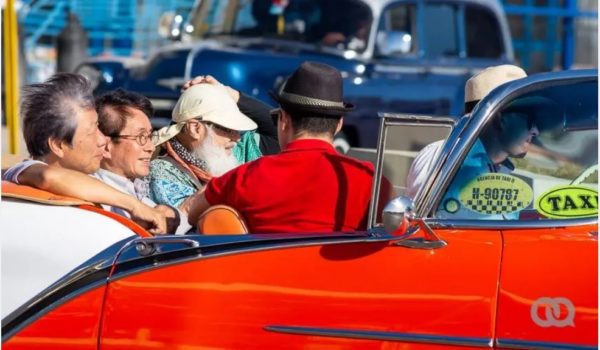
If it is assured that the idea is to add, the most coherent thing should be to eliminate the activity of tourist guide among the prohibited, and thus begin the summation through their ventures. Why mask the activity after a project and not issue a certification that allows you to perform in compliance with the relevant controls and certifications? The most consistent with the current times would be to reach an agreement of quantities, rules, certifications and obligations, as has already happened with the direct partner of that guide: the taxi driver.

The most consistent with the current times would be to reach an agreement of quantities, rules, certifications and obligations, as has already happened with the direct partner of that guide: the taxi driver. (Photo: Yamil Lage/AFP)
The answer continues to revolve around fear, as if prohibitions solve the problem of the lack, quality or private practice of that activity. If we know that it is going to happen anyway, why not take advantage of it and legislate in favor of the institutions and the State?
In the golden age of tourism, when we were trying to reach five million visitors, many ways of playing the role of guides emerged; say the driver of a taxi, an old car, a buggy, a pedicab, not including other "unscrupulous" – quote from the Minister of Labor – who ended up locating Calixto García on the heights of G Street, observing the city from its peak, and José Miguel Gómez modestly facing the sea. Meanwhile, the real guide, the one trained in respect for heritage and love for history, never achieved his claim.
It is practical in much of the world that the tourist guide receives a state or national certification and is agency with an operator, given the economic benefits that this offers, but it is still relatively independent; that is, even in the face of the apparent freedom they hold, the guides remain allied at the behest of large operations.
In our case, if a tour guide can enter a certain amount into the budget six months of the year, it would be necessary to calculate if the average taxes, between 15 and 30%, are not reasonable amounts, especially when that guide may also operate for an agency; or maybe not, but have enough vision to manage direct investment in a territory through a local development project, via tourism and its corresponding promotion.
It cannot be preferable to persecute any "unscrupulous" person who stalks the tourist, than to stipulate the mechanisms that lead to proper certification. Coachmen, taxi drivers, bicycle riders and drivers of old cars, are no more tourist guides than those who unsuccessfully request the release of the activity.
In a short time, tourism will prosper again and again an immense police force will be required to identify who sells, who promotes, who rules, who moves; when, by a simple formal stroke, all that apprehension could be turned into hard currency for the country.
Decree-Law 44 of 2021 on the exercise of Self-Employment has been cited as containing the impediment to perform the functions of a guide, but in that same decree it is already exempt from the prohibitions to accommodation and the carrier. So, there is no need to postpone the next step. In my opinion, the imbrication of actors continues to be the determining factor. However, the actors that appear must be born with full capacities to contribute, a key term to get us out of the economic crisis.
Why break your head in the making of a project that convinces someone that it does not violate prohibitions and thus get an approval? Is it not known what needs to be eliminated to bring to fruition the drama that for months hundreds of people and groups have made visible in the networks through publications and pages?
The real solution will be to interwoven, decriminalize the function and sit down to negotiate on scopes. Then the projects will come. In this way, all our visitors will be able to know that those who observe the city from the height of Avenida G are far from carrying a name as illustrious as that of the one who decided to shoot himself before falling prisoner of Spanish power.
See Facebook page of Tourist Guides for Legalization as Self Employed Workers (TCP)
https://www.facebook.com/groups/2874041822811366
*****************************
Tour Guides Organize and Lobby for Legal Status in Cuba
By Ely Justiniani Perez (El Toque)
HAVANA TIMES – On September 22, 2021, Ministry of Tourism officials agreed to meet with three representatives from a wide group of tour guides, who have mobilized to attain legal status for their work activity in Cuba.
Despite there just being three chosen representatives due to the “epidemiological situation”, the majority of the collective’s members agree that “the meeting will be a step forward since the representatives will know how to put the group’s interests on the table, after having a well-articulated and inclusive discourse, which covers the many different interests of its members.”
The Tour Guides group for Legal Status as a Self-Employment Activity has over 800 members, including guides at state-companies, tour managers and self-employed guides with different education backgrounds. Their fundamental objective is “to advocate for the legalization of Tour Guides as a self-employment activity and for legal status that allows them to work in an empirical manner.”
Some reasons to legalize the activity
Ever since the activity appeared on the list of banned professions within the private sector, tour guides haven’t stopped in their mobilization to reverse this measure. In this regard, the Tour Guides group for Legal Status as a Self-Employment Activity has undertaken key actions such as providing arguments about the benefits of this self-employment activity for the country’s economic development.
The promotion of tourism in Cuba has been highlighted as one of the points on which the private guides could have a strong impact. “The country needs a lot more than tourism to make progress, and if every self-employed guide became a publicist and showed all the great things the island has to offer, this would lead to a substantial increase in the number of visitors,” points out Felix Ruano, a tour guide with many years of experience.
“Guides all over the island are fighting for this work to gain legal status, and they are burying themselves in work to create innovative and attractive products to ensure tourism develops in many parts of the country. The Government has spoken on many occasions about eliminating unnecessary illegal activities and this is a clear example of this,” Ruano emphasizes.
Debates over recent months have delved into the value of independent tourist activity as a source of jobs and revenue for the country, in terms of taxes.
Arturo Mesa, a professor and translator with over 20 years of experience in the field, points out that “this form of employment could offer a great variety of tourism offers, by developing activities that are tailored to traveler interests and by designing packages for small groups, for people who don’t like to travel in large groups like the ones that national agencies normally operate.”
“We want the productive forces to feel more committed and motivated, and that we all have the chance to participate in national progress,” Mesa underlines.
Negotiations in context
On February 10, 2021, the Ministry of Labor and Social Security issued a list of 124 economic activities banned in Cuba’s private sector, and this included tour operator services, as well as travel agencies.
Up until this moment, “independent” tour guides operate without a license or were using a license that allowed them to somehow justify their relationship with small groups of tourists. This professional activity had been in a legal limbo, as there was no law that supports it, but there weren’t any laws to prohibit it either. Now there is.
As a result of these regulations, heated debate broke out on social media between people who were linked to the sector, who sent dozens of letters to the corresponding bodies. They also shared an online petition to get legal status for private travel agencies – over 1500 people signed the document.
In response to these complaints, the Ministry of Labor and Social Security wrote a written response to one of its signatories, in May of 2021. It stated, “with the new Social/Economic Strategy to push the national economy in the interest of encouraging local development and the production linkages between the public sector and private forms of management, the Ministry of Labor and Social Security, alongside the Ministry of Tourism, would analyze and assess the pertinence or not of the exercise of these activities and others relating to the tourism sector.”
Weeks later, on June 7, 2021, the Cuban Republic’s Official Gazette published Resolution 132/21 by the Ministry of Tourism (MINTUR), which is a new series of regulations for “national travel agencies”.
The document defines national travel agencies as “legal persons in Cuba, whose social mission is to carry out activities that consist in mediating between travelers and tour operators”; and also explains that the authorization of these lies in MINTUR’s hands.
While the regulations don’t explicitly state who can create these agencies, it recognizes that natural Cuban persons (the Self-Employed are natural persons) can be “providers of tour services” that offer “the sale of these in groups, programs, circuits, excursions or other tourist services” via State travel agencies. What will this relationship be like? It doesn’t say; but there’s no doubt that the lack of clarity in these regulations is also a glimmer of hope for the more optimistic.
Then on August 19th, to many people’s disappointment, the activity of travel agencies and tour operators appeared on the banned list again within the framework of decrees and resolutions that regulate private sector enterprises (which include micro companies, non-agricultural cooperatives and self-employment). Thus, the struggle for legal status continues…
My comment:
It is completely up to Cubans to determine the structure of their economy. The Ministry of Tourism and practitioners of tourist services will have an open and honest dialog about what is in the best interest of the country and its people.
As an outsider with years of experience in organizing groups of people to people travelers to both Cuba and Vietnam, I can observe two things:
1) Many US travel agents, now known as travel advisers, carry out their work as independent businesses or even from their homes. They organize trips for individuals, families and small groups of friends or colleagues. Their typical number of clients do not mesh easily with the very competent state agencies in Cuba, both from an administrative and economic perspective.
If they can partner with counterparts in Cuba who are cuenta propistas or micro-small-medium enterprises they can greatly expand the number of travelers they send with benefit to casas particulares, hotels, paladars and restaurants.
In addition, many Americans are accustomed to booking their own international travel, including casas, hotels, transportation and local services. They will gravitate to similarly independent Cuban providers, especially if they are confident that they are professionally trained and registered with official agencies. Beyond that the role of state agencies at the micro level is bureaucratic and deadening. The linkage between Cubans and Americans will come in the old fashioned way, by reputation, and via the modern version, internet ratings.
2) When I first organized trips to Vietnam in the 1980s, travel was entirely a state operation from tour guides to hotels and transportation with many practical constraints on growth. Today it is a mix of private and state enterprise at every level and phenomenally more successful because of its diversity. The productivity of the sector has enabled not subverted the leadership role of the Communist Party.
Links to three academic studies about the development of Vietnamese tourism can be found here: https://cubapeopletopeople.blogspot.com/2021/06/privatization-and-growth-of-tourism-in.html
This is the official site of Vietnam Tourism https://vietnam.travel/
https://havanatimes.org/features/tour-guides-organize-and-lobby-for-legal-status-in-cuba
